
BYOK Explained: Why You Bring Your Own Google AI Key for Blogging
Understand why Bring Your Own Key (BYOK) lowers costs, protects privacy, and gives businesses total control when running a Google Gemini blog.
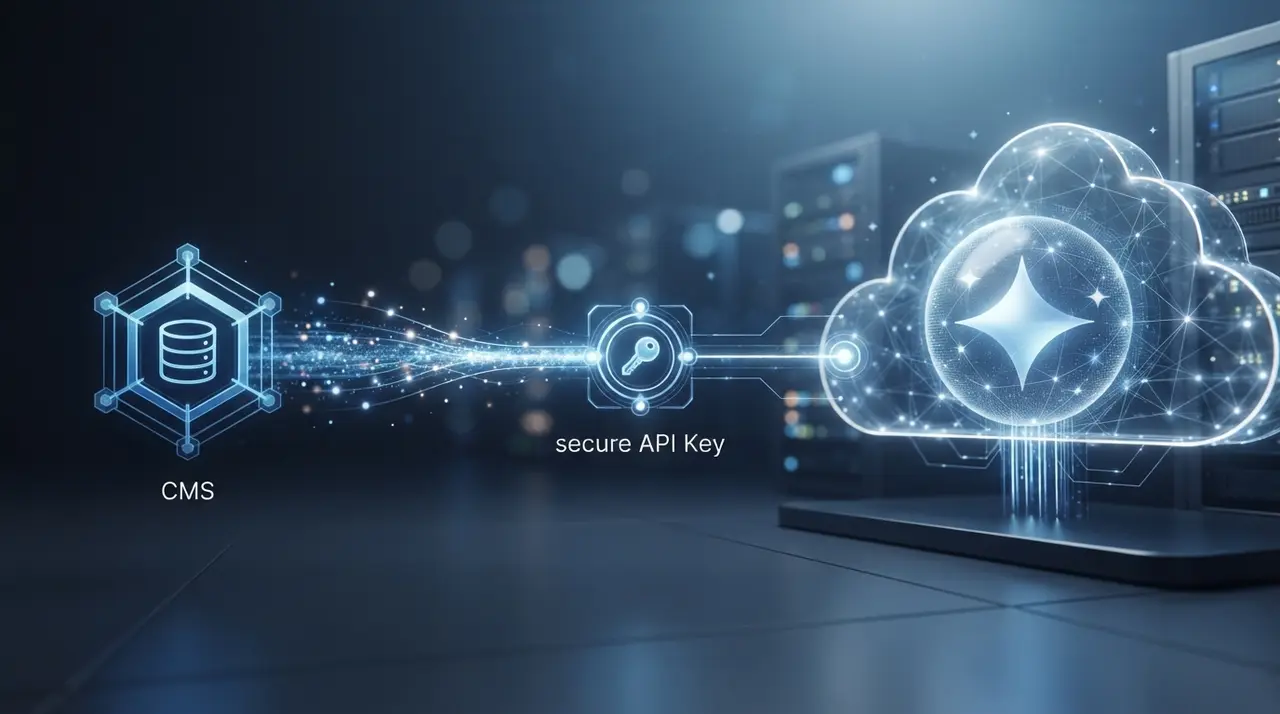
Bring Your Own Key (BYOK) for BYOK AI content generation is an architectural model where companies connect their personal API credentials—such as a Google Gemini key—directly to an editorial execution system like BlogPost Automático. This structure ensures businesses pay raw API consumption costs directly to the model provider while maintaining full ownership over data privacy and usage rate limits.
For companies seeking to establish predictable organic acquisition channels, the decision between choosing a bundled software subscription or leveraging a BYOK model impacts operating margins, content security, and scaling potential. Understanding how BYOK functions enables marketing managers and agency owners to make informed infrastructure decisions.
How BYOK lowers AI content publishing costs
Using your own API key removes third-party markup on token consumption, allowing high-volume blogging at wholesale infrastructure costs. Traditional content platforms that bundle language model fees often mark up API charges by 300% to 500% to protect their own financial margins against heavy users. With BYOK, the software platform bills solely for its workflow management and automation software, while Google bills you separately for exact token usage.
For a business publishing 30 to 50 long-form articles per month for a Google Gemini blog, token costs paid directly to Google AI Studio are often negligible compared to flat-rate software markups. This separation of infrastructure costs from platform software costs makes scaling content output economically sustainable for growing companies.

Data privacy and ownership with Google Gemini API
Connecting a private Google Gemini key via BYOK prevents your company inputs and domain knowledge from being pooled into public model training sets. When enterprise users generate content using standard consumer AI interfaces, their prompts and corporate context can be used by default to train foundational models unless explicit enterprise opt-outs exist. Commercial API connections operate under strict enterprise terms where data inputs remain strictly private.
By managing your own API key through Google Cloud or Google AI Studio, your business maintains a direct contractual agreement with Google regarding data governance. Editorial guidelines, brand voice parameters, and proprietary industry insights passed to the model remain isolated to your organization.
BYOK vs. bundled SaaS subscription: A direct comparison
Selecting between BYOK and bundled AI subscription models depends on your monthly publication volume, budget predictability requirements, and demand for API control.
| Evaluation Factor | BYOK Model (e.g., Google Gemini) | Bundled Platform Subscription |
|---|---|---|
| Token Pricing | Wholesale cost paid directly to Google | Marked-up cost bundled into software tiers |
| Usage Caps | Governed by your direct Google API tier | Strict monthly word or article limits |
| Data Privacy | Enterprise API data protection policies | Varies by vendor middleware routing |
| Cost Scalability | Linear with actual token consumption | Requires upgrading entire software plans |
| Setup Complexity | Requires generating and pasting an API key | Zero configuration required |
Mini-case study: Scaling content for a B2B consultancy
A corporate financial advisory firm needed to build topical authority across 40 complex accounting topics without overspending on third-party content platforms. By utilizing BlogPost Automático under a BYOK model with Google Gemini, the firm routed their editorial briefs directly through their own Google Cloud API key.
The result was a continuous editorial operation that reduced production costs by over 70% compared to agency quotes, while keeping sensitive financial client frameworks private. The firm established a predictable organic search presence while retaining complete control over their software stack and token consumption.

How to get and set up your Google Gemini API key
Setting up a Google Gemini key requires accessing Google AI Studio, generating a key string, and saving it within your publishing system settings. The process takes less than five minutes and requires no programming knowledge.
- Step 1: Log into Google AI Studio using your corporate Google account.
- Step 2: Navigate to the API Key section and click "Create API Key in new project".
- Step 3: Copy the generated alphanumeric string safely.
- Step 4: Paste the key into your BlogPost Automático credentials panel to unlock automated generation.
Once connected, the editorial engine communicates directly with Google servers whenever a new article scheduled on your editorial pipeline is ready for research, drafting, or optimization.
Frequently asked questions
What is BYOK in AI content generation?
BYOK stands for Bring Your Own Key, a software model where users insert their personal API credential from an AI provider into a third-party automation tool. This setup lets users pay raw model costs directly to the AI provider while using the automation tool for workflow execution.
Is a Google Gemini API key expensive for blogging?
Google Gemini API keys offer pay-as-you-go pricing with generous free tiers for basic usage. For most small to mid-sized blogs publishing regularly, monthly API token charges are negligible compared to traditional copywriting or bundled software costs.
Does using my own API key affect content quality?
Using your own API key yields identical model intelligence and output quality as using platform-provided keys, because the underlying language model is exactly the same. Quality is determined by the platform's editorial instructions, context injection, and structural guidelines rather than who owns the API key.
What happens if my API key runs out of quota?
If your API key reaches its tier rate limit or quota, generation pauses until the quota resets or billing limits are adjusted in your Google Cloud account. Platforms built for BYOK notify you of API response errors so you can quickly manage your tier directly with Google.